




Renovation budgets have tightened across most residential markets, and homeowners are scrutinizing every line item on a project estimate. The case for bathtub refinishing over full replacement has always been strong on paper, but the current market conditions have made it more compelling than ever. For contractors who offer reglazing as part of their service mix, understanding the business argument behind the choice helps position the service with confidence during client consultations.
The Cost Gap Between Refinishing and Replacement Is Significant
The price difference between a professional reglazing job and a full tub replacement is not marginal. Replacement involves removing the existing fixture, disposing of it, sourcing a new unit, modifying plumbing connections if needed, and finishing the surrounding surfaces where the old tub was seated. Each of those steps carries a cost, and they compound quickly into a project that is several times the price of refinishing the existing fixture.
Bathtub refinishing eliminates most of that scope entirely. The fixture stays in place. The plumbing remains untouched. The surrounding surfaces do not need to be disturbed. The client gets a result that looks and performs like a new tub at a fraction of the total outlay, and the contractor completes the job in a single visit rather than managing a multi-trade project over several days.
Bathtub Refinishing Protects Contractor Margins
Replacement jobs carry more moving parts, more subcontractor coordination, and more opportunities for scope expansion that can erode margins if not managed carefully. Reglazing is a contained, single-trade service with predictable material costs, a defined labor window, and a clear deliverable. That predictability is valuable from a business planning perspective.
A contractor who can complete a reglazing job efficiently, with reliable materials and consistent results, builds a service line that scales well. Adding more reglazing jobs to a schedule is straightforward compared to adding more full replacement projects, which each require their own coordination overhead.
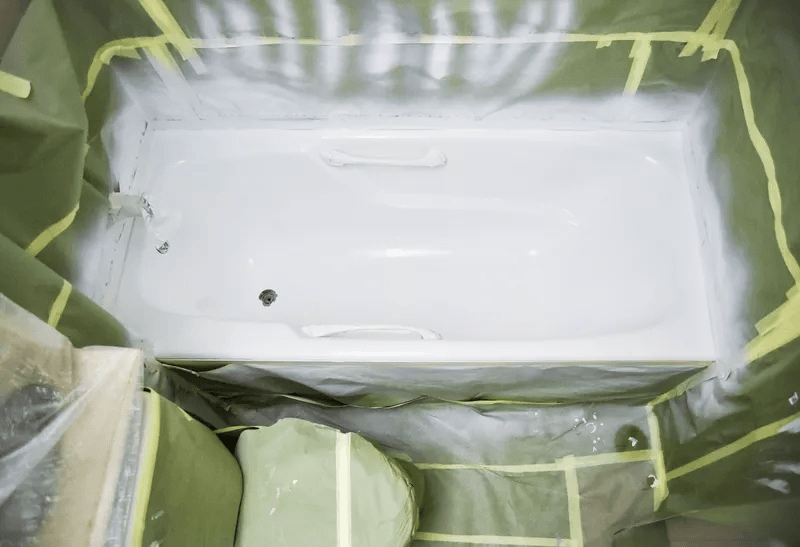
For businesses focused on volume and margin consistency, bathtub refinishing offers a cleaner path to growth than replacement-heavy work. An improved schedule also plays a direct role in how profitably these jobs stack across a week or month of work.
The Displacement Factor in Occupied Homes
Replacement projects require the bathroom to be out of service for an extended period. In an occupied home, that disruption is a real inconvenience that clients factor into their decision-making. A multi-day bathroom outage affects daily routines in ways that homeowners feel immediately, and the prospect of that disruption can cause hesitation even when the client wants the upgrade.
Bathtub refinishing typically is completed in a single day, with cure time requiring only a short window before the fixture is back in use. That timeline is far easier for clients to accommodate, which reduces the friction in the sales conversation and accelerates the decision. Contractors who can credibly promise a minimal-disruption outcome alongside a strong visual result have a persuasive combination that replacement cannot match on either dimension.
Market Conditions Favor Bathtub Refinishing Right Now
Rising material costs, longer lead times on fixtures, and broader renovation budget compression have all shifted the calculus in favor of surface restoration over full replacement. Homeowners who might have opted for a new tub in a more favorable economic environment are now more receptive to refinishing as a legitimate, high-quality alternative rather than a compromise.
This shift creates a market opportunity for contractors who are positioned to deliver professional reglazing work at scale. The demand is there, and the competition from full replacement is less aggressive than it has been in previous market cycles. Contractors who have invested in the right materials, equipment, and technique are well-placed to capture that demand consistently.
Longevity and Performance When the Work Is Done Correctly
One of the objections contractors occasionally encounter is the perception that refinishing is a temporary fix rather than a durable solution. That perception is rooted in experiences with substandard workmanship or inferior materials, not with professional-grade reglazing executed correctly. A bathtub refinishing job done with proper surface preparation, the right primer system, and a quality topcoat performs reliably for years under normal residential use.

The durability of the result depends heavily on process discipline. Surface contamination, moisture, inadequate deglossing, or skipping the primer step all compromise adhesion and shorten the life of the finish. Contractors who follow proven processes and use professional-grade materials produce results that reinforce the value of refinishing over replacement. The finish should be evaluated before every handoff, and a structured pre-completion inspection is one of the most reliable ways to protect both the result and the contractor's reputation.
Refinishing as Part of a Broader Service Offering
Bathtub refinishing gains additional business value when it is positioned alongside complementary services rather than offered in isolation. A client who books a reglazing job is often a strong candidate for a wall system installation, tile reglazing on the surrounding surfaces, or other bathroom refresh work that can be completed in the same visit or scheduled as a natural follow-on project.
Contractors who present refinishing as one component of a broader surface restoration service rather than a standalone offering tend to achieve higher average job values and stronger client retention. The reglazing job becomes an entry point into a longer client relationship rather than a one-time transaction. That positioning benefits both parties and makes the business case for investing in reglazing capability even stronger over the long run.
Superior Bathtub Refinishing with TopKote
At ISI Bathroom Systems, we distribute TopKote products specifically for professional reglazing on bathtubs, shower bases, and tile surfaces.
The TopKote system is built around Crosslink III butyl primer and low-VOC Glaze topcoat, engineered for reliable adhesion and a durable finish when surface preparation and application are executed correctly. Unlike systems that require acid etching or epoxy primers, TopKote is designed to streamline the professional reglazing process without compromising performance.
Visit our online shop to learn more about our products and offerings.


